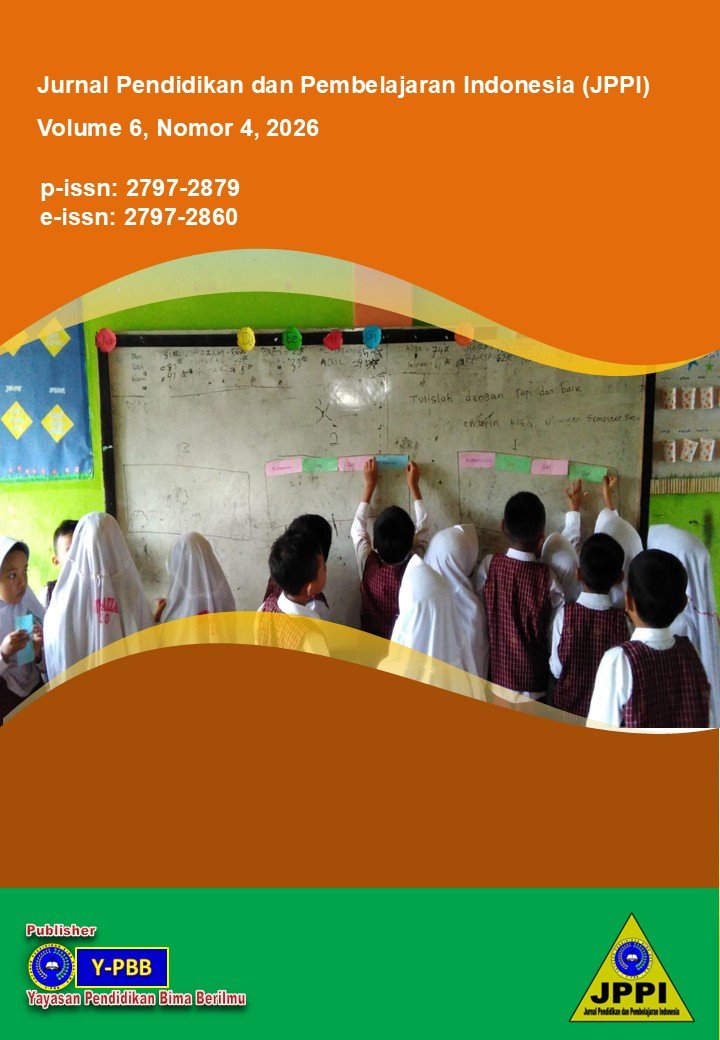
Penerapan Metode GASING Berorientasi Etnopedagogi dalam Pengembangan Kompetensi Profesional Guru Matematika Sekolah Dasar
DOI:
https://doi.org/10.53299/jppi.v6i4.5723Keywords:
etnopedagogi, kompetensi profesional guru, metode GASING, penelitian tindakan, permainan MalondaAbstract
Kompetensi profesional guru matematika sekolah dasar masih menjadi tantangan, terutama dalam mengemas pembelajaran yang mudah dipahami, menarik, dan dekat dengan budaya peserta didik. Penelitian ini bertujuan mendeskripsikan penerapan metode GASING (Gampang, Asyik, dan Menyenangkan) berorientasi etnopedagogi dalam pengembangan kompetensi profesional guru matematika sekolah dasar. Penelitian tindakan model Kemmis dan McTaggart dua siklus (64 jam pelatihan) dilaksanakan pada 32 guru Kelompok Kerja Guru Gugus 3 Kecamatan Lasalimu, Kabupaten Buton, dengan permainan tradisional Malonda sebagai konteks pembelajaran penjumlahan. Data dikumpulkan melalui lembar observasi aktivitas guru, lembar observasi keterlaksanaan pembelajaran, serta angket kepraktisan, persepsi efektivitas, dan kepuasan pelatihan, kemudian dianalisis secara deskriptif kuantitatif. Rata-rata aktivitas guru meningkat dari 82,54% pada Siklus I menjadi 91,18% pada Siklus II. Keterlaksanaan pembelajaran mencapai 96,71% (sangat baik), kepraktisan 96,07% (sangat praktis), persepsi efektivitas 88,69% (setuju), dan kepuasan terhadap substansi pelatihan 92,52% (sangat puas). Temuan utama menunjukkan bahwa suasana pembelajaran berubah lebih cepat daripada kedalaman pedagogis guru: aspek menyenangkan hampir sempurna (99,55%), sedangkan indikator memulai dari pengetahuan awal siswa dan memberikan penguatan konsep paling rendah (masing-masing 87,50%). Simpulannya, pelatihan ini terlaksana dengan sangat baik dan dinilai praktis sehingga layak dijadikan model pengembangan kompetensi profesional guru, sedangkan peningkatan kompetensi itu sendiri masih perlu diuji melalui pengukuran sebelum dan sesudah tindakan.
References
Alwasilah, A. C., Suryadi, K., & Karyono, T. (2009). Etnopedagogi: Landasan praktek pendidikan dan pendidikan guru. Kiblat Buku Utama.
Ball, D. L., Thames, M. H., & Phelps, G. (2008). Content knowledge for teaching: What makes it special? Journal of Teacher Education, 59(5), 389–407. https://doi.org/10.1177/0022487108324554
Barroso, C., Ganley, C. M., McGraw, A. L., Geer, E. A., Hart, S. A., & Daucourt, M. C. (2021). A meta-analysis of the relation between math anxiety and math achievement. Psychological Bulletin, 147(2), 134–168. https://doi.org/10.1037/bul0000307
Blömeke, S., Kaiser, G., König, J., & Jentsch, A. (2020). Profiles of mathematics teachers’ competence and their relation to instructional quality. ZDM Mathematics Education, 52(2), 329–343. https://doi.org/10.1007/s11858-020-01128-y
Burns, A. (2010). Doing action research in English language teaching: A guide for practitioners. Routledge.
Cronbach, L. J. (1951). Coefficient alpha and the internal structure of tests. Psychometrika, 16(3), 297–334. https://doi.org/10.1007/BF02310555
D’Ambrosio, U. (1985). Ethnomathematics and its place in the history and pedagogy of mathematics. For the Learning of Mathematics, 5(1), 44–48.
Darling-Hammond, L., Hyler, M. E., & Gardner, M. (2017). Effective teacher professional development. Learning Policy Institute. https://learningpolicyinstitute.org/sites/default/files/product-files/Effective_Teacher_Professional_Development_REPORT.pdf
Departemen Pendidikan Nasional. (2007). Peraturan Menteri Pendidikan Nasional Nomor 16 Tahun 2007 tentang Standar Kualifikasi Akademik dan Kompetensi Guru. Departemen Pendidikan Nasional. https://sma.kemdikbud.go.id/data/files/Permendiknas%20Nomor%2016%20Tahun%202007%20Tentang%20Standar%20Kualifikasi%20Akademik%20dan%20Komp.pdf
Desimone, L. M. (2009). Improving impact studies of teachers’ professional development: Toward better conceptualizations and measures. Educational Researcher, 38(3), 181–199. https://doi.org/10.3102/0013189X08331140
Garet, M. S., Porter, A. C., Desimone, L., Birman, B. F., & Yoon, K. S. (2001). What makes professional development effective? Results from a national sample of teachers. American Educational Research Journal, 38(4), 915–945. https://doi.org/10.3102/00028312038004915
Gay, G. (2018). Culturally responsive teaching: Theory, research, and practice (3rd ed.). Teachers College Press.
Iqlima, N. N., Apriani, I. F., & Muharram, M. R. W. (2026). Pengaruh kemampuan pemecahan masalah melalui pembelajaran GASING pada materi penjumlahan bilangan cacah di sekolah dasar. Cokroaminoto Journal of Primary Education, 9(3), 1282–1292. https://doi.org/10.30605/cjpe.9.3.2026.9019
Kemmis, S., & McTaggart, R. (1988). The action research planner (3rd ed.). Deakin University Press.
Knowles, M. S., Holton, E. F., & Swanson, R. A. (2015). The adult learner: The definitive classic in adult education and human resource development (8th ed.). Routledge.
Kuder, G. F., & Richardson, M. W. (1937). The theory of the estimation of test reliability. Psychometrika, 2(3), 151–160. https://doi.org/10.1007/BF02288391
Ladson-Billings, G. (1995). Toward a theory of culturally relevant pedagogy. American Educational Research Journal, 32(3), 465–491. https://doi.org/10.3102/00028312032003465
Nuari, L. F., Prahmana, R. C. I., & Fatmawati, I. (2019). Learning of division operation for mental retardations’ student through Math GASING. Journal on Mathematics Education, 10(1), 127–142. https://doi.org/10.22342/jme.10.1.6913.127-142
Prahmana, R. C. I., & Suwasti, P. (2014). Local instruction theory on division in mathematics GASING. Journal on Mathematics Education, 5(1), 17–26. https://doi.org/10.22342/jme.5.1.1445.17-26
Republik Indonesia. (2005). Undang-Undang Nomor 14 Tahun 2005 tentang Guru dan Dosen. https://peraturan.bpk.go.id/Details/40266/uu-no-14-tahun-2005
Riduwan. (2012). Skala pengukuran variabel-variabel penelitian (Cet. ke-9). Alfabeta.
Rosa, M., & Orey, D. C. (2011). Ethnomathematics: The cultural aspects of mathematics. Revista Latinoamericana de Etnomatemática, 4(2), 32–54. https://funes.uniandes.edu.co/funes-documentos/ethnomathematics-the-cultural-aspects-of-mathematics/
Schoorl, J. W. (2003). Masyarakat, sejarah, dan budaya Buton. Djambatan.
Shulman, L. S. (1986). Those who understand: Knowledge growth in teaching. Educational Researcher, 15(2), 4–14. https://doi.org/10.3102/0013189X015002004
Surya, Y. (2012). GASING mathematics 1B: Matematika GASING 1B. PT Kandel.
Thurm, D., & Barzel, B. (2020). Effects of a professional development program for teaching mathematics with technology on teachers’ beliefs, self-efficacy and practices. ZDM Mathematics Education, 52(7), 1411–1422. https://doi.org/10.1007/s11858-020-01158-6
Yeager, D. S., Bryan, C. J., Gross, J. J., Murray, J. S., Krettek Cobb, D., Santos, P., Gravelding, H., Johnson, M., & Jamieson, J. P. (2022). A synergistic mindsets intervention protects adolescents from stress. Nature, 607, 512–520. https://doi.org/10.1038/s41586-022-04907-7
Downloads
Published
How to Cite
Issue
Section
License
Copyright (c) 2026 Jurnal Pendidikan dan Pembelajaran Indonesia (JPPI)

This work is licensed under a Creative Commons Attribution 4.0 International License.